
Icing on the Summit
2013-12-06 17:24:32.000 – Mike Dorfman, Weather Observer
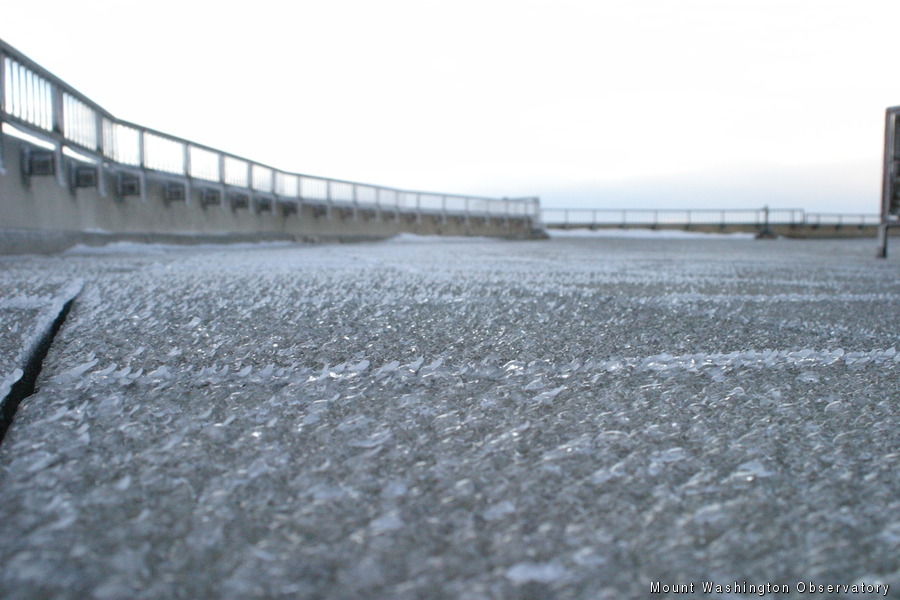
Glaze Ice Covering the Deck
Icing events can occur at any time of the year-if you have read the book “Not Without Peril,” you are familiar with one of the stories in which a mid-summer icing event allowed glaze ice to coat the entire range many inches thick. More commonly, however, are shoulder-season icing events, like the one that occurred last night and this morning. The thin coating the summit received, combined with winds that made it feel like gravity had switched directions, was enough to make observations interesting today. Carefully wandering around the deck, the small bits of glaze ice that I kicked up each observation tumbled downwind and through branches of more glaze ice, turning the deck into what sounded like a giant rainstick.
While we enjoy our conditions on the summit, our eyes have been focused on a consistent, large swath of ice over Arkansas and Texas for the past day or so. While glaze ice (or any weather, for that reason) is usually mostly exciting and only a little scary on the summit, it is quite the opposite when it is necessary to travel through an ice storm.
Encountering inclement weather above tree line and coming across inclement weather in your car may seem unrelated, but they both pose a serious risk to the inexperienced or uninformed. Above tree-line, the danger lies within the remoteness of your location, the increased severity of the weather, and the topography of the mountain. Although the weather may be much more mild lower down on a road, the momentum of a vehicle poses a huge risk to the driver. Getting to a destination late by taking it slow or postponing your trip will rarely cost you your life, but pushing through inclement weather may. Whether traveling above tree line or trying to drive through a storm, be sure to take a look at an appropriate forecast and use your best judgment.
Observer footnote: Our year-end fund drive is taking place through December 31, and we need your support. Please make a tax-deductible donation of any amount here. As a nonprofit, people-powered institution since our founding in 1932, we need your help to continue our work! Thank you in advance for your generosity.
Mike Dorfman, Weather Observer
Hiker Safety
Hiker Safety By Fawn Langerman, Dave Fatula and Julie Saccardo USFS Trailhead Steward volunteering season has begun, and hiker safety is on my mind. Truthfully, hiker safety is always on my mind, but more
Watch Our 2026 Annual Meeting and Read About the Highlights
Watch Our 2026 Annual Meeting and Read About the Highlights By Drew Bush United States Representative Maggie Goodlander headlined Mount Washington Observatory’s 2026 Annual Meeting, and she set the tone right from the start.
Seek the Peak Spotlight: The Middleton Family
Seek the Peak Spotlight: The Middleton Family By MWOBS Staff Every summer, the White Mountains offer no shortage of reasons to get outside. Trails stretch in every direction—endless miles of terrain, summits that each